
Created to Need Others
I was sixteen when a farmer trusted me with a large grain truck during wheat harvest. I felt the weight of it—the responsibility to stay focused, to be on time, to do my part. The combine worked the field, but when its tank filled with grain, everything stopped until a truck pulled alongside to receive the load and haul it to the elevator. The harvest window was narrow. Every hour mattered. And the most powerful machine in the field was completely dependent on a teenager behind the wheel to keep moving.
I never forgot that. No single member of the harvest work team could complete the work alone. Not the farmer. Not the combine operator. Not me. The whole operation only worked because everyone showed up, did their part, and trusted the others to do theirs.
That picture has stayed with me for decades—because it turns out it’s not just how farming works. It’s how we were designed.
So if independence is a myth—even a harmful one—what is the goal?
It might help to think carefully about the word autonomy. The word itself comes from two Greek roots: autos, meaning self, and nomos, meaning law or custom. Though autonomy is often used as a synonym for independence, in the biblical perspective the autonomous self stands not independently but in healthy dependence on God. For a follower of Jesus, the deepest law governing life is not self-rule or self-sufficiency. Rather, Kingdom life is lived within community, under God’s law—the Scriptures and the lordship of Christ—with mutual accountability, love, and respect.
In that light, the self finds its rightful place: self-giving, selfless, unselfish.
Perhaps we could say it this way. Independence declares, “I am in charge.” Autonomy recognizes that I am not—and that I function best under the One who is.
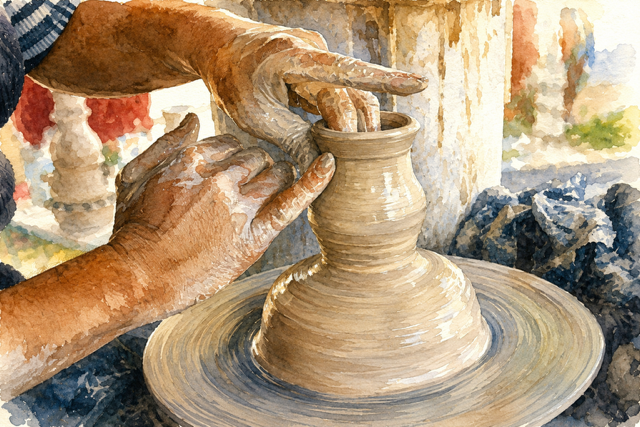
"We are the clay, and you our potter." (Isaiah 64:8)
This is why the three-self model in missiology—self-supporting, self-governing, self-propagating—is not wrong. It becomes wrong only when we read it through the lens of Western independence rather than Kingdom autonomy. A self-governing church is not a church that answers to no one. It is a church that answers first to Christ, then to its own people, and remains deeply connected to the rest of the body of Christ worldwide. A self-supporting church is not a church that hoards its resources. It is a church that owns its responsibility to contribute to the needs of the world. A self-propagating church is not a church turned inward. It is a church so caught up in the mission of God that it cannot help but send.
Autonomy in the Kingdom always points outward. Independence always points inward.
There is a verse that has always stopped me cold. It appears twice in the book of Judges—once in the middle, and once as the very last word of the entire book. The narrator’s verdict on an entire generation: “In those days there was no king in Israel. Everyone did what was right in his own eyes.” (Judges 17:6; 21:25)
That is independence in its purest—and most tragic—form. When the highest moral authority in your life is you, you are the king. And history, biblical and otherwise, tells us how that ends.
The lessons learned about the value of others in your life, and especially the value of the One who governs all—who grants perspective you cannot give yourself, who reframes intentions and goals you cannot see clearly on your own—are perhaps among the most valuable lessons a human being can learn.
We were not made to rule our own kingdoms independently. We were made in his image, to reflect his goodness—a shared identity rooted in the beauty of the Trinity, the Three-in-One God who has existed eternally in perfect relationship: Father, Son, and Holy Spirit. Independence has a tendency toward isolation. If God himself exists in community, perhaps our need for one another is not a weakness to overcome. It is a reflection of who he is.
The grain truck only matters because there’s a harvest. And the harvest only happens because no one tries to do it alone.
Eric Spangler serves as Area Director for Free Methodist World Missions—Asia. He writes about mission, leadership, and what it means to do life better together. This post was developed in collaboration with Barnaby, his AI writing partner